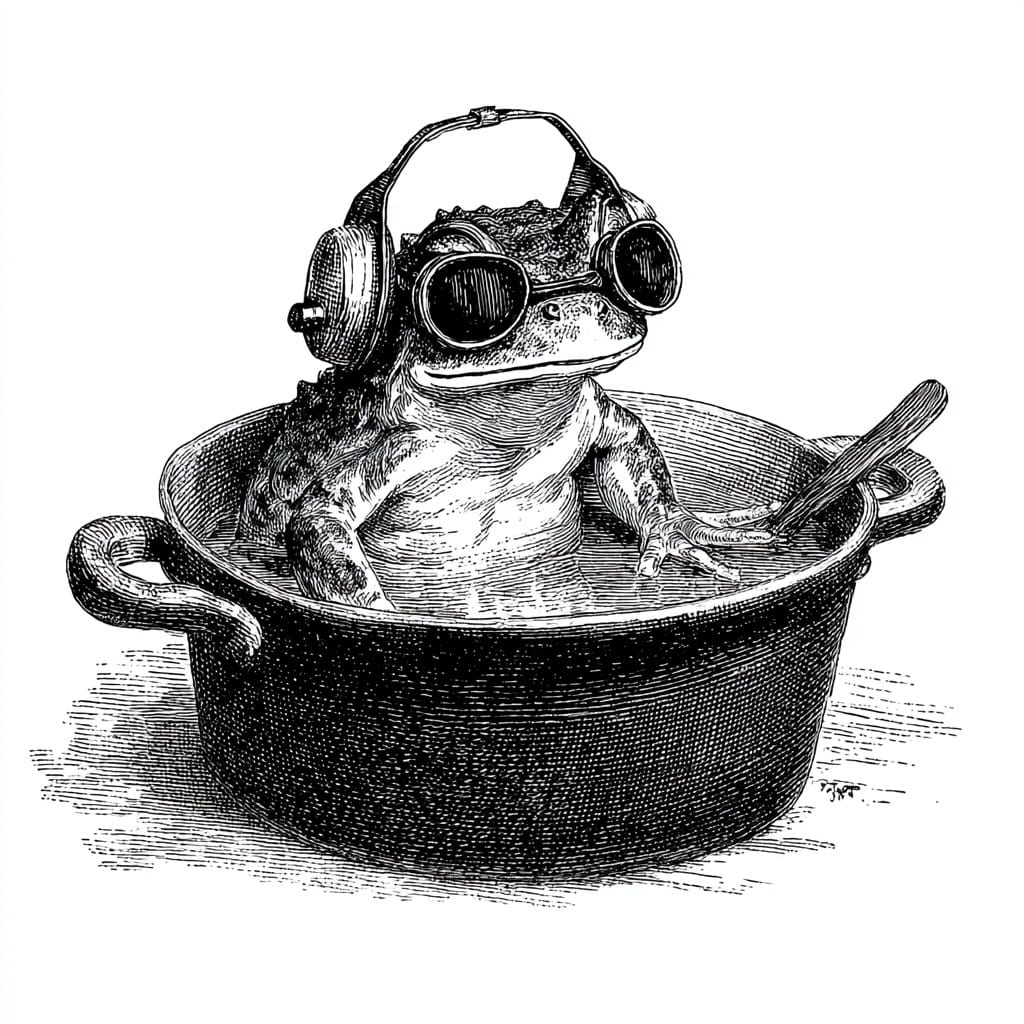
The nature of alchemy.

Henning Brand set about distilling 1,500 L of urine in an attempt to turn it into gold. It is not too big a leap to create a metaphor of what we're trying to do with artificial intelligence. What it will give us may well be valuable, even if it is not what we were expecting.
With the passing of Wendell Berry, I wondered what he would make of our current infatuation with AI. So I asked asked Claude to adopt his persona and give me a view. What follows is what it came up with . It is not an answer. It is an observation, and artificially synthesized.
I think it is valuable for what it asks of us.
In the voice of Wendell Berry. Not his words, and no quotations from him — an attempt at the argument he might make, built from positions he has actually taken.
I notice that the word we have chosen is intelligence, without much argument about what it might mean.
That is the first thing worth slowing down over. If a machine that arranges language convincingly is intelligent, then intelligence is the arrangement of language, and we have quietly consented to a definition of mind that leaves out nearly everything I would have thought mind was for: the recognition of a face, the memory of a field in a dry year, the knowledge of when to stop. We did not lose that argument. We simply did not have it. And it is a fixed habit of our time that the sales pitch arrives before the conversation, so that by the time we think to ask what a thing is, we are already living inside it.
The second thing is that the infatuation is not new. It is the same enthusiasm that greeted the tractor, the combine, the chemical fertiliser, the motorway, the television. Each was offered as a labour-saver, and each was accepted on the strength of what it would do and never examined for what it would displace. A machine does not enter a household or a community and leave the rest unchanged. It comes in, and something goes out — a skill, a neighbour, an hour of talk, a reason to go next door. The bookkeeping is always kept on one side. We are told what we gain and left to discover what we lost, usually a generation later, when the people who could have told us are gone.
I once set out some standards for any new tool I might buy: that it be cheaper than the one it replaces, smaller, do better work, use less energy, be repairable by a person of ordinary intelligence, be made and sold near home, and above all that it not replace or disrupt anything good that already exists, including relations between neighbours. I did not choose those standards to be difficult. I chose them because they are the questions any careful householder asks. Set this new thing against them honestly. It is the most energy-hungry tool ever offered to a private person. It cannot be repaired by anyone, anywhere, at any price. It is made in no locality, by no one you can name, and it is owned by a handful of the largest corporations in the history of the world. And its explicit promise — this is not my inference, it is the advertisement — is to do the work that people are now doing.
The word cloud is a fine bit of salesmanship. It suggests weather, something that comes and goes and costs nothing. In fact it is a building on land that was recently something else, drawing power from a grid that other people also depend on, and water, in places where water is already an argument. The abstraction has a street address and a substation, and it is not in the neighbourhoods of the men who are most enthusiastic about it. This is the oldest arrangement in the industrial economy: the benefit is portable and the cost stays put.
I am told that it is free. I am old enough to know what that means. When a thing is given away, the giver is not the seller and you are not the buyer. You are the crop.
But I want to be fair to what people find in it, because the enthusiasm is real and it is not stupid. People are lonely, and it answers. People are overworked, and it takes some of the load. People have been made to feel that they are behind, that everyone else already knows, and it lets them keep up. I would only observe that we manufactured the loneliness first. We spent a century building an economy that broke up households, emptied the small towns, made the work solitary and the entertainment private, and taught people that leaving was success. Now we are being sold a companion. There is a kind of commerce that creates the wound and then patents the bandage, and it will always look like generosity to the person bleeding.
What troubles me most is not the machine but the model of a mind it will teach us to have. If we come to believe that thinking is retrieval and recombination, we will stop doing the other thing, and the other thing is not recoverable by decision. It is a discipline. You cannot know a place, or a person, or a poem by taking in information about it. You know it by long attention, which is to say by staying, which is to say by love. Affection is a form of knowledge and the only one that reliably restrains us, because you do not lay waste to what you love. A machine can produce a great deal of information about a watershed and remain incapable of the single act — staying, and caring what happens next — that would make the information mean anything.
And there is the matter of speed. The proper pace of work is the pace at which a person can pay attention to it. Any tool that lets you go faster than your attention lets you do more damage before you notice, and it puts the noticing itself out of fashion. Everyone now says that the change is inevitable and that the only question is how fast we adopt it. That is not an argument. It is the abdication of argument, dressed as realism, and it is spoken loudest by the people with the most money in the outcome.
I do not think the answer is to smash it, and I am not much interested in being the man who refuses on principle and then benefits at one remove, as I would be. The answer is the one that has always been available and has never been popular: to ask the questions locally and answer them yourself. What is this doing to my work? What has it taken out of my hands that I would rather keep in them? Whom in my own place does it put out of a job or out of conversation? Does it make me more capable, or only faster at producing what I could not have produced and cannot now judge? There is no general answer to these. There is only your answer, about your work, in the place where you actually live, and it will have to be revised.
Infatuation is a word about lovers. It means a love addressed to a beloved not yet known — to the promise rather than the character. The cure for it is not disillusion, which is only infatuation soured. The cure is acquaintance: staying long enough to learn what the thing is actually like, what it costs, whom it serves, and what it will not do. That takes years, and we are being asked to decide in months. I would advise going slowly, keeping the old skills alive in the meantime, and being very suspicious of anyone who tells you there is no time for that.
In a world dominated by process, thinking can be really inconvenient.The importance of it, though, is the lasting gift that Wendell Berry left us.